Find the fault before you swap the part.
Squawk Talk is a troubleshooting trainer that runs in your browser. You get a squawk, a schematic and a meter. Predict each reading before you take it, then call the fault.
For A&P and avionics students, new techs, Part 147 programs and repair shops. Early access: the full trainer isn't open yet; the weekly puzzle is free.
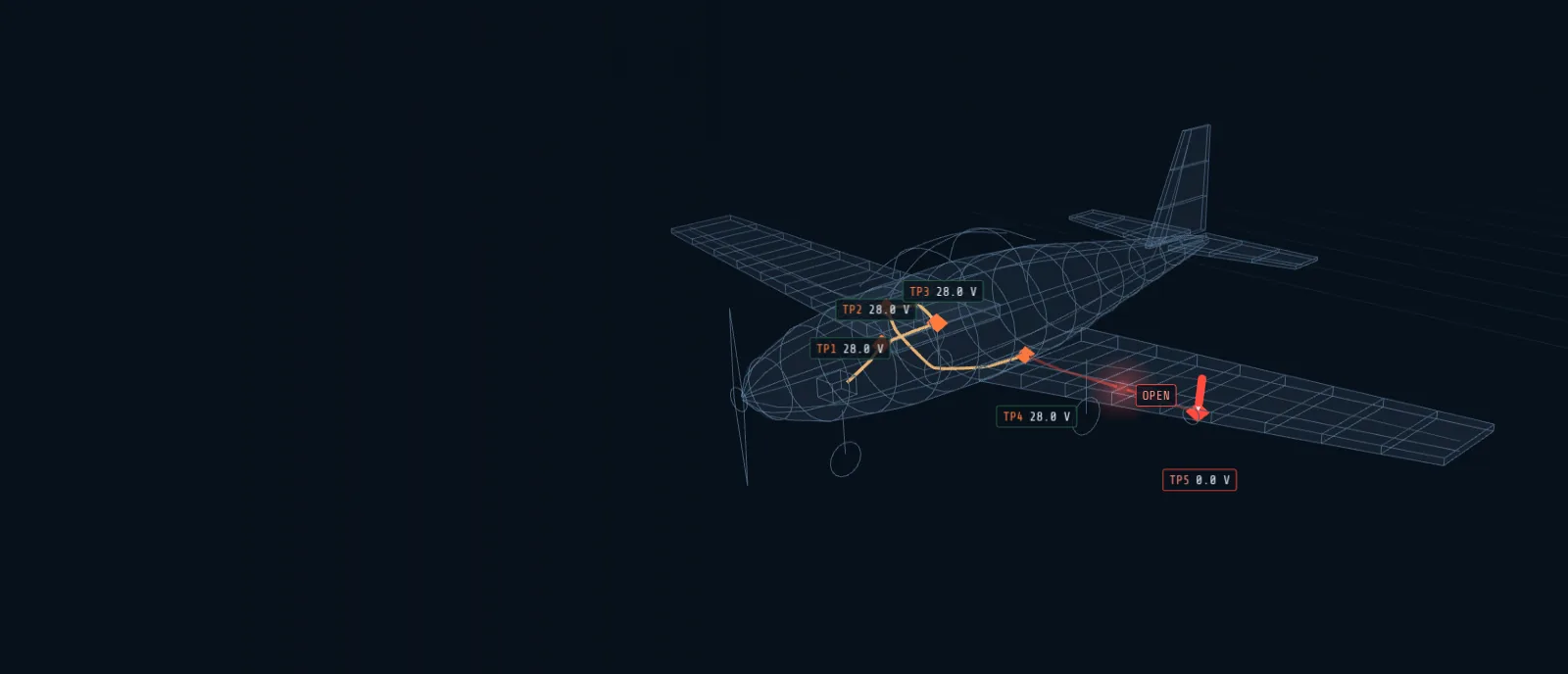
A simulated job, five seconds long. The aircraft and its wiring are fictional.
This week's squawk
Six test points, one fault. Pick a point, say what it should read, then read it. Call the fault when you're sure.
A new one goes up every Monday. Every past puzzle is still playable.
How a job works
From Senior Tech up, every job runs this way, whether it's a corroded regulator ground or a crushed ARINC 429 cable. The weekly puzzle is a short version.
Squawk
Read the write-up the way the pilot left it, and the logbook for what was worked on last.
Schematic
Read the system brief and the wiring sheet. The meter stays locked until you do.
Predict
Before each reading, say what a healthy circuit reads at that point.
Measure
Volts and ohms. Higher levels add the bus analyzer, scope, VSWR and TDR.
Call it
Write it up: where, what caused it, and the repair. Every part you swap goes on the bill.
Debrief
A score out of 100, your predictions next to the healthy values, and what a pro checks first.
One real job, start to finish
Screens from the current build, Senior Tech level. Landing light inop on a TR-140; the LDG LT breaker popped twice in cruise and the nav lights flickered each time.

The work order, the schematic and the meter
CB2 is tripped and J10 is split. The fuselage side of pin 4 reads tens of ohms to ground; the wing side reads OL.

Say what it should read
With power off, the landing light feed to ground should read tens of kΩ through the LED driver. It read 49.8 Ω.
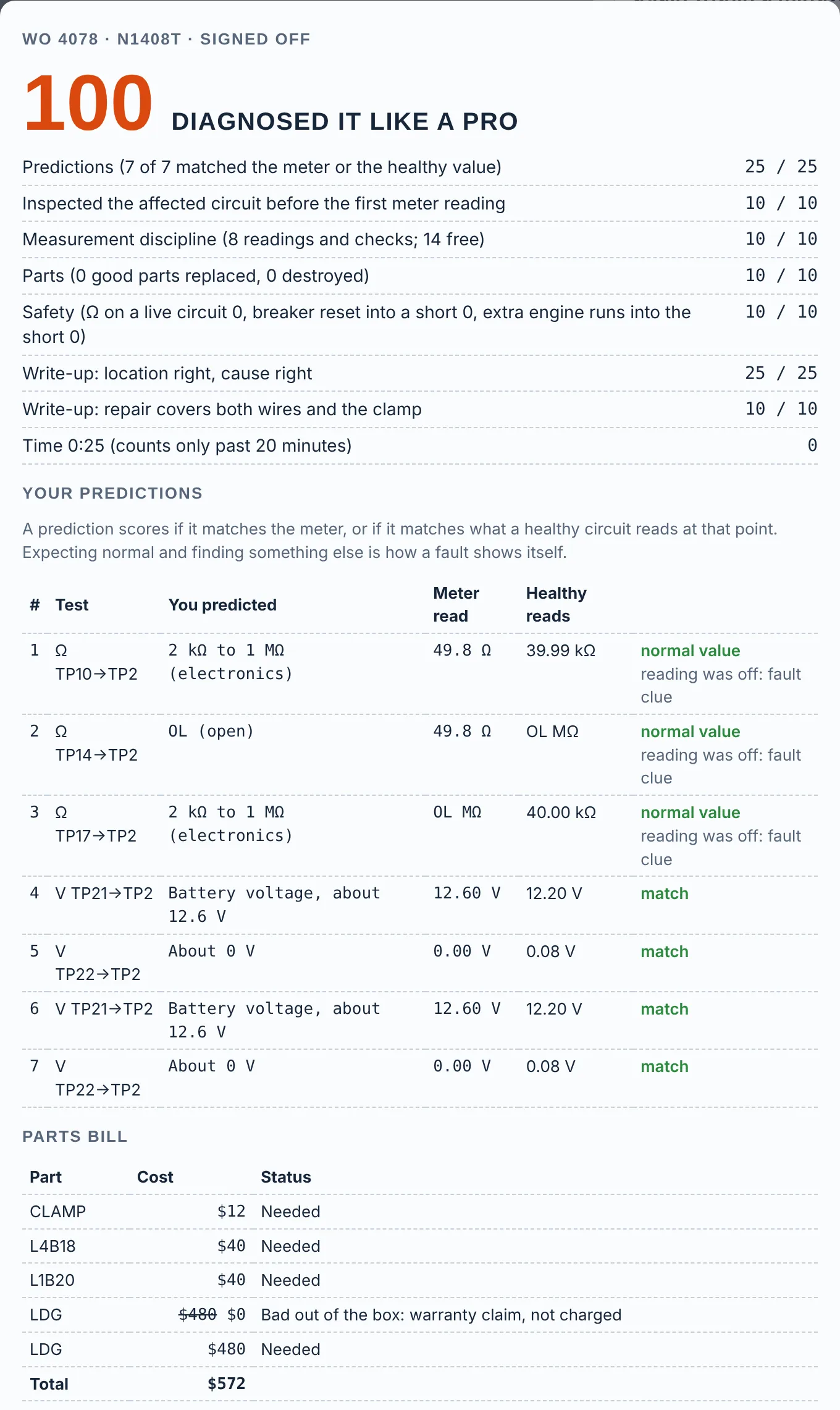
Every prediction next to the healthy value
And the parts bill. The first new landing light was bad out of the box, so the job checks you proved power and ground before buying another. Cause: a clamp at FS 112 never went back in after a door seal job.
Who it's for
Troubleshooting practice for Part 147 programs
Your students get as many faults as they're willing to work, in a browser, between lab sessions. Every job ends with a debrief that shows how they worked it: predictions, readings, parts swapped and the write-up.
Jobs are mapped to FAA-S-ACS-1 elements such as AM.I.A.S8, troubleshoot a circuit. The mapping is our own alignment.
Founding-school pilot
One class (up to 25 students) free for a term, with a training plan mapped to your airframe electrical block and the ACS electrical elements, a kickoff, a mid-term check-in and an end-of-pilot summary.
After the pilot, schools from $2,500 a year.
Teach new techs to prove the fault before they pull the box
A new tech who swaps an LRU to see if the squawk clears costs you the removal, the shipping, the bench fee and the airplane's time on the ground. In Squawk Talk they make that mistake on a sim, and it only costs them points.
Shop trial
3 free seats for 30 days with a 4-week onboarding plan built around your shop's common squawks, plus a week-2 check-in.
After the trial, shops from $999 a year for 5 seats.
Practice for the oral and practical, and for your first year on the floor
Work jobs alongside your shop time. The habit that costs shops money is swapping a box to see if the squawk goes away. Here that habit only costs you points.
Start free
Squawk of the Week and the Line Tech I jobs are free. Every level is $39 a year for students, $79 a year for working techs.
Know how your airplane's electrical system is supposed to behave
Learn how the system is meant to work, so you can follow what your shop tells you.
What's in the trainer
Paid plans include every level. Line Tech I and II teach the basics with clean faults; from Senior Tech up, jobs include damage the way it really happens.
Line Tech I and II
Opens, shorts, relays and shared wiring, one sheet at a time
Senior Tech
Twin charging systems, intermittents, chafed bundles
Avionics Tech
ARINC 429 with a bus analyzer, BITE pages
RF Specialist
Coax, antennas, VSWR and TDR
UAS I to IV
Multirotor, enterprise, VTOL and Group 3 unmanned systems
Engineer I
Wiring, circuit protection and load analysis
What this is, and what it isn't
I'm an avionics tech in Colorado. Experienced techs have told me a sim always has a smoking gun, and real snags often don't. They're right. Squawk Talk won't replace time on the aircraft or a good mentor.
What it can do is build the habits that come first: understand the system, know what the meter should say before you look, and prove the fault before you order a part.
It's a training aid. The aircraft and wiring are fictional, it isn't maintenance data, and it isn't FAA-approved training. On a real aircraft you follow the manufacturer's current data.
Pricing
Priced like test prep, not a streaming service. Nothing is charged today. Pick the plan you'd actually buy and the waitlist form records it.
| Plan | Price | What's in it | Waitlist |
|---|---|---|---|
| Free | $0 | Squawk of the Week, Line Tech I jobs, basic score history | I'd use this |
| Student | $39/yr or $19 for 3 months | Every level. Any technical or engineering program. | I'd pay for this |
| Tech | $79/yr | Every level, plus new tracks as they ship | I'd pay for this |
| Founding lifetime | $149 once | Everything in Tech, for good. Launch only, limited spots. | I'd pay for this |
Schools from $2,500 a year. Shops from $999 a year for 5 seats. Full pricing
Join the waitlist
Two minutes: your role, what you'd pay, and what you'd want to practice first. You'll hear from me when early access opens.